The cold autumn wind sliced through the empty street, chasing yellow leaves across the cracked sidewalk and rattling the faded brick facades of a neighborhood forgotten by time itself. Officer Carlos Mendoza had carried his badge for twelve long years, navigating the grimiest corners of the city—from brutal overdoses to wrecks, from domestic chaos to the kind of pain you couldn’t bandage. Yet nothing, not a single life he’d seen, readied him for what stopped him dead on that chilly morning.
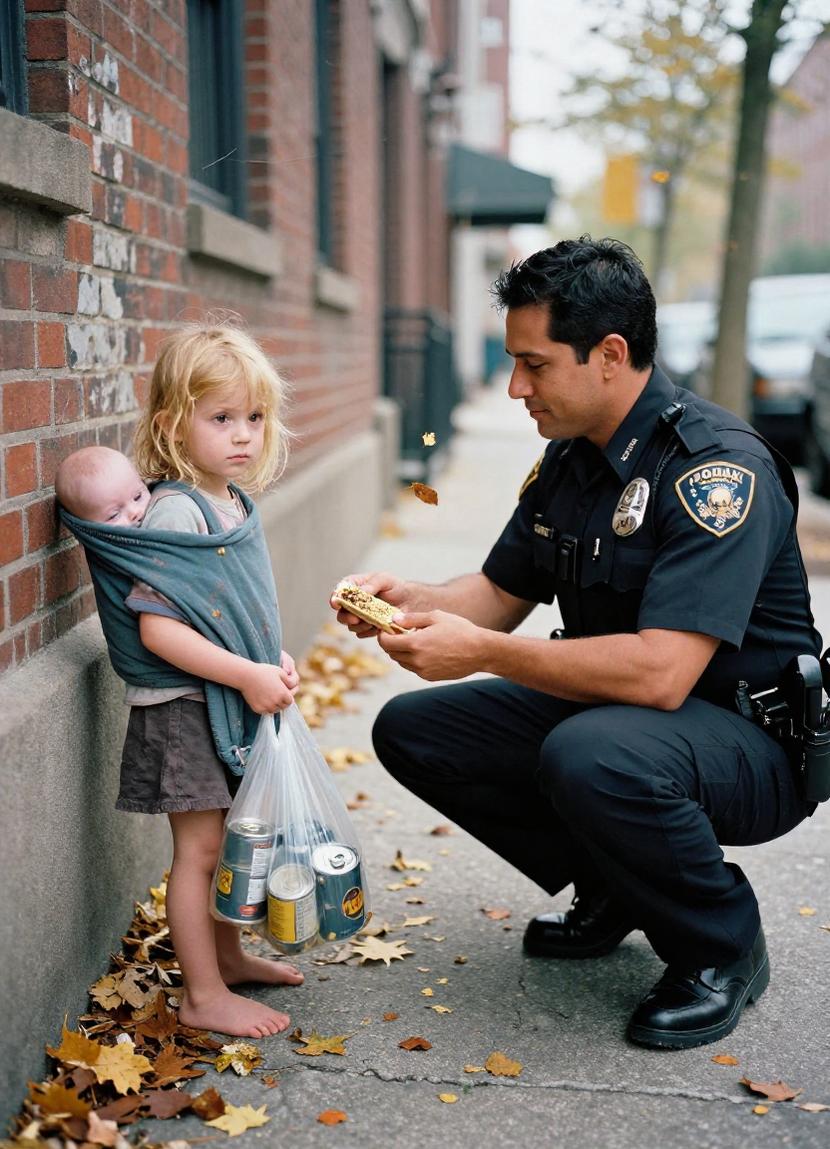
Beneath a heavy canopy of golden and rust-leaf hues, a barefoot child trudged through the biting cold. She was barely five. Tangled blond hair clung to her tear-streaked cheeks and dusted face. In one tiny, grimy hand, she dragged a battered plastic bag stuffed with crushed cans and scraps of discarded trash, painstakingly gathered, step by frozen step.
Then Carlos’s eyes caught the sling—an old, faded blue T-shirt knotted awkwardly across her tiny shoulder and chest. Nestled inside was a baby, his fragile head resting just beneath her chin. His skin was pale, lips cracked and dry. Even in sleep, he seemed drained of life.
Carlos’s breath hitched.
He’d witnessed poverty’s harsh face before. He’d seen children struggle against impossible odds. But never this. Never a child carrying the weight of another—a sister and guardian wrapped into one, scavenging survival in a world that refused to see her.
He’d responded to a call about suspicious behavior near the community bin area, expecting maybe a homeless adult or some rowdy teens. Instead, he found this heartbreaking scene.
The girl bent cautiously, picking up a dented soda can, sliding it into her beaten bag with the practiced ease of hard-won survival. This was no first time, no sudden misfortune. This was her grim reality. Her oversized shirt slipping off one narrow shoulder revealed her frailness, a little body too thin for the merciless cold.
The baby stirred, a faint, weary sound escaping before he nestled closer against her chest.
Carlos noted the cracked lips, the flush rising from the cold, the constant protective tilt of her body shielding the baby from the biting wind. This was far beyond poverty—it was abandonment etched in flesh and frozen breath.
She didn’t notice him at first.
Her wide brown eyes nervously darted over the ground in search of anything salvageable. When she finally lifted her gaze and caught the uniform, she froze, every muscle taut with silent terror.
Fear clouded her young face.
Carlos saw it clearly—the fear wasn’t of a stranger. It was the fear of authority, the kind bred from a life taught to run.
He crouched slightly, lowering his silhouette to diminish the threat that hung between them. For a long moment, silence and wind filled the space; leaves rattled in the branches overhead as the girl adjusted the sling.
The baby’s shallow breaths reminded Carlos of his own daughter, safe and warm miles away—probably tangled in a fight over cartoons and snacks this very morning.
The weight of that contrast hit Carlos like a blow.
Slowly, his voice softened. ‘What’s your name, little one?’
Her answer was a fragile whisper, a thread of sound hesitant to unravel. She said her brother was the baby, that they’d been hiding behind the rusty washhouse, their mother gone out three nights ago to find food—and never come back.
She’d been trying alone—keeping him warm, feeding him scraps, wrapping him in torn cloth. She remembered someone once said bottles could be traded for money, so she gathered them, clawing hope from garbage.
Carlos’s throat tightened painfully. This wasn’t merely a tragedy—it was a cry for urgent rescue.
The baby’s fragile life needed warmth, nourishment, doctor’s care. The girl needed safety and protection—immediately.
But Carlos also knew the delicacy of this moment: one wrong move, and she would run. If she fled, she might vanish forever into the shadows.
So he made a choice.
He decided not to act like just a cop.
He chose to be a human being.
Carefully, he reached into his jacket and pulled out a granola bar saved for long shifts. Slowly, he unwrapped it, holding it at a respectful distance.
The girl hesitated, eyes flickering between him and the offered food, caught in an eternal war between fear and hunger.
Finally, one small, trembling step forward.
That step sparked the first fragile thread of trust in a life woven from fear and neglect.
But what Carlos couldn’t know was that after that first bite—after the soft sigh of brief relief—the words she whispered next would shatter his heart more thoroughly than any training ever had.
Those words marked the dawn of change—not just for her and her baby brother, but for Carlos himself.
Because sometimes, the deepest kindness springs not from abundant resources—but from someone who simply refuses to turn away.
Carlos Mendoza could have treated this like any other call. Another file. Another story to close.
But he didn’t.
He stayed.
And in that choice, he became the fragile bridge between despair and hope.
In a world spun fast and indifferent, let this be your reminder: a single moment of true compassion can rewrite a life’s story. You don’t have to fix everything.
Sometimes, you just need to stop—and care.