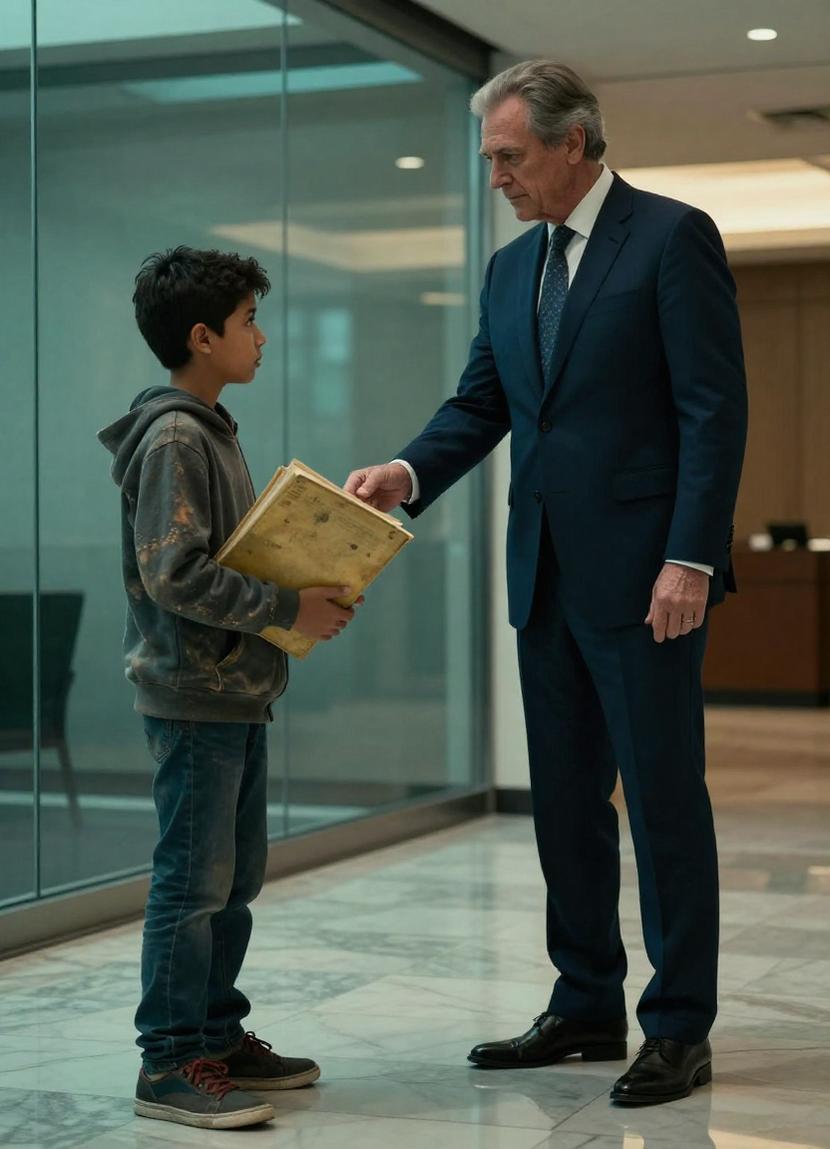
Elias Moreno learned early in life that promises carry a weight far beyond words. When he was only seven, standing beside the sterile glow of a hospital bed, he gripped the frail hand of his grandfather, Samuel Moreno—the one person who ever spoke his name as if it echoed significance. With his last ounces of strength, the old man breathed into Elias’s ear: “When the time comes, go where I told you. Don’t hesitate. You’ll know what to say.”
Back then, the boy barely grasped the meaning. But each word etched itself indelibly into his heart.
Three days after the funeral, the moment unfolded.
The sky hung heavy and gray that afternoon, a sharp scent of rain weaving through the faint aroma of freshly baked bread drifting in from the boulangerie across the street. In their cozy kitchen, Elias sat quietly while his mother, Isabel, carefully broke the seal on an envelope of wax and yellowed paper.
Her eyes shifted as she read the message. ‘He left instructions for you,’ she said, her voice soft but steady. “Go to Summit Crest Financial Plaza. Ask for Mr. Langston. The executive floor.”
Elias nodded once, the weight of the unknown pressing in, yet no questions escaped his lips.
At dawn, he gathered the few treasures Samuel had entrusted him: a plastic folder thick with faded documents, a brass key worn and chipped at the edges, and a fragile handwritten note, ink faded but firm—‘For today. Be brave. Never let money make you feel less than you are.’
Summit Crest Financial Plaza towered over the Riverview District like an imposing citadel of glass and steel. Elegance and authority seeped from every surface—the sharp clang of polished shoes, the crisp cut of tailored suits, the confident hum in the air. Elias’s threadbare sneakers screamed silent defiance among the sea of power.
Still, he stepped inside.
The marble floor stretched beneath glowing lights, gilding hurried footsteps and the murmur of urgent conversations. The concierge’s gaze lingered on Elias, a mixture of puzzlement and suppressed amusement playing across his face.
“I need to see Mr. Langston,” Elias said, clutching the folder as though it were armor.
His voice was quiet but unwavering.
They escorted him to the upper floors, trading subtle smiles—those patronizing glances adults wear when entertaining a momentary distraction. On the executive level, whispers rippled through the room. Eyes narrowed. Stealthy chuckles trickled behind glass walls.
From the shimmering crowd, a man in an impeccably tailored navy suit stepped forward, smirking. “Hey, kid. Lost your way?”
Elias exhaled deeply, flipping open his folder. His words began to flow, earnest and clear. But before he could get past the first sentence, a heavy door at the far end swung open.
Mr. Langston appeared.
The instant Mr. Langston’s gaze fell on Elias and the folder cradled in his hands, the room’s laughter shattered, dissolving into stunned silence.
He didn’t speak immediately. Instead, he stood motionless, his eyes locked on the folder. Slowly, deliberately, his stare rose to meet Elias’s face. The boy remained unnervingly still—no fidgeting, no distraction. His complexion pale but resolute, bearing a gravity far beyond his years, as if he understood the invisible weight tucked between those pages.
The potent energy that had filled the room moments before collapsed under the hush. Mid-conversation, voices halted; glasses ceased their clinking; even the very air seemed to retreat, sensing a boundary crossed.
Finally, Langston’s voice emerged—cool, controlled, yet stripped of earlier ease:
“Where did you get that?”
Elias’s throat tightened. His fingers gripped the folder—not with possession, but reverence—as if it belonged to a ghost.
“My grandfather,” he answered quietly. “Samuel Moreno.”
The name slipped softly but landed like thunder.
Langston’s posture shifted imperceptibly but unmistakably. His shoulders tensed; his eyes sharpened. Recognition flickered across his face like a shadow passing over sunlit ground.
Step by cautious step, he approached, as if the floor beneath him had turned brittle. Reaching out, he accepted the folder—handling it with the delicate care usually reserved for relics. Opening it, his hands trembled—not with anger, but with the resonance of memory.
The gathered guests leaned closer without realizing. Unease rippled; a throat cleared nervously; a poised figure shuffled, sensing a veil lifting.
Langston paused at the final page.
Silence stretched on.
Then, slowly, he closed the folder—tenderly, as if cradling a living thing.
“You should have called,” he murmured.
The words weren’t for Elias.
They floated toward an absence in the room—an echo of a man forgotten by all but a few.
Langston lifted his gaze, voice calm but absolute.
“Clear the room.”
Confusion flared. Hesitation flickered on hardened faces. Shock, subtle but sharp, rippled through the accustomed elite.
“I said clear the room,” Langston repeated, voice steeling into finality.
Chairs scraped, glasses were hurriedly set down, polished shoes echoed as people withdrew. In minutes, the VIP floor emptied—leaving only Langston, Elias, and a poised woman in a gray suit who stood nearly invisible against the wall, as though she had been waiting for this moment all along.
“That’s my mom,” Elias said softly, nodding toward the elevator.
Langston inclined his head once.
“Bring her up.”
When the elevator doors parted again, Isabel stepped out and froze.
The panoramic glass walls swallowed her in vastness. The glittering city below seemed distant, untouchable—a world she’d never known she should belong to. Her first impulse was to retreat.
But Elias was already at her side, lifting her hand firmly, grounding her in certainty.
“It’s okay, Mom,” he whispered.
She exhaled shakily, nodding, though her eyes never left Langston.
He motioned toward the sleek table. “Please. Sit.”
They did.
“I owe your family the truth,” Langston began.
He recounted a crisis decades past—a financial storm that nearly toppled the institution he now helmed. He spoke of Samuel Moreno, who had stepped in quietly when no one else dared. Of whispered strategies behind locked doors. Of invisible risks taken without thanks. Of decisive acts that saved more than just numbers.
He described a trust, forged in silence. Documents sealed to remain untouched until the precise moment.
“That account,” Langston said, resting a hand on the folder, “was never meant for premature access. Your grandfather was clear: protect it until the time was right.”
Isabel’s voice trembled. “How much… is in it?”
Langston named a sum so vast it seemed to tilt the room on its axis.
Isabel gasped softly—more wealth than she had known in a lifetime, enough to erase doubt, enough to redraw their future, and enough to scare her deeply.
Elias said nothing.
He listened intently.
“There’s one last thing,” Langston added, sliding the brass key across the table.
He moved to a built-in wall safe, opened it, and produced a smaller, timeworn envelope.
“Left with special instructions,” he said.
Elias unfolded the letter inside with care.
It was never about the fortune.
It spoke of restraint; of generosity when survival was no longer at stake; of holding onto your roots when the world tries to rewrite your story; of never letting money define your worth or erase your duty to others.
When they stepped out of Summit Crest Financial Plaza that evening, no one cast a mocking glance at the boy in worn sneakers.
Outside, the Riverview District pulsed with its familiar rhythms—traffic roaring, voices weaving together, life moving onward like an endless river.
But Elias held Isabel’s hand tighter than ever.
“We’re going to be okay,” Isabel whispered—perhaps to herself more than to Elias.
Elias nodded.
He already knew.
Because a promise—patient, silent, and fiercely guarded—had finally been honored.