The flight from Barcelona to Madrid was meant to be a brief escape—just a couple of hours soaring over the Spanish skies. But for Javier Romero, it dragged on like an unbearable torment. At forty years old, Javier was the epitome of success: CEO of one of Spain’s most powerful tech firms, a bank account overflowing with wealth few could imagine, and a reputation that cracked open doors across continents. And yet, strapped into his plush first-class seat 30,000 feet above the ground, he felt utterly bankrupt—helpless in a way no amount of money could fix.
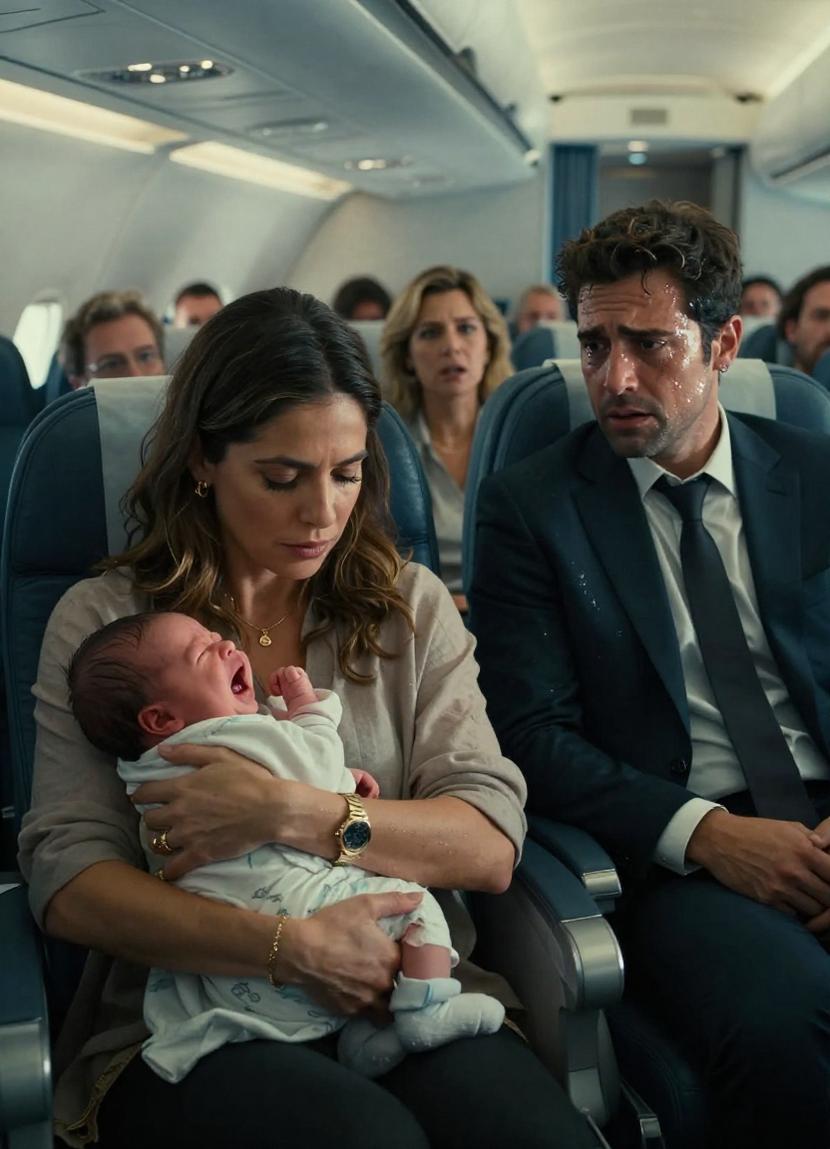
Cradled in Javier’s arms was Mateo, his three-month-old son, whose cries shredded the air relentlessly. This wasn’t the simple hunger or discomfort cry any parent might anticipate; it was a raw, soul-piercing wail, born of a mysterious anguish Javier was powerless to soothe. Two hours had passed in this deafening agony. Clad in a €5,000 suit now damp with cold sweat and frustration, Javier tried every trick taught by nannies and parenting books: the bottle, pacifier, pacing endless laps down the aisle, gentle rocking. Nothing calmed Mateo.
Around him, the genteel first-class passengers—the very people who once looked upon Javier with deference—now flashed thinly veiled annoyance. Their eyes carried a silent judgment, sharp and unforgiving: “How can a man who commands millions fail to quiet his own child?” But deeper than this stinging social gaze was Javier’s own torment. Every desperate sob from Mateo felt like an accusation, an echo of loss and loneliness.
Because sitting beside him in this luxurious prison was a constant reminder of Isabela’s absence. His beloved wife had died giving birth, leaving behind a son whose cries seemed to say, “You’re not her. You don’t know how to hold me.”
Several rows back, beyond the first-class curtain, Lucía Fernández watched in quiet empathy. Twenty-eight, with eyes that bore the weight of too many hardships, Lucía held her own little miracle: Sofía, her peaceful two-year-old daughter, nestled asleep on her lap. Lucía wasn’t clothed in silk or tailored threads—her worn jeans and simple T-shirt spoke of a life lived in the trenches of struggle. Her pockets were nearly empty, the last few euros scraped together to buy tickets to Madrid, where she hoped to find work cleaning homes or babysitting after her husband abandoned them for another woman.
Mateo’s unceasing cries tugged at Lucía’s heart like an invisible thread connecting all mothers to any suffering child. Through the thin curtain she watched the elegant man unravel. His hands trembled, his posture stiffened with anxiety. Javier held Mateo as if he were fragile glass or a ticking bomb, careful but untouched by warmth.
The cries escalated, cutting through the cabin’s hushed murmurs. Flight attendants looked on, helpless and exchanging glances thick with exhaustion. The tension was suffocating. Javier, teetering on the edge of collapse, sank back into his seat, closed his eyes, and wished for escape.
That’s when Lucía rose—a quiet resolve steadying her movements. She gently unbuckled her seatbelt, careful not to rouse Sofía, and crossed the aisle toward the first-class curtain. A flight attendant stepped forward, voice sharp and cautious.
“Ma’am, you can’t enter first class.”
Without looking, Lucía’s gaze was locked on Javier and the wailing infant.
“Please, let me try,” she said softly but with a firm conviction that brooked no refusal.
Javier looked up, meeting Lucía’s gaze—dark eyes devoid of condescension or pity, only a deep, human understanding that cut through his despair. In that moment, he sensed she might be the lifeline he didn’t know he needed. He didn’t yet grasp the magnitude of this encounter at 30,000 feet—that the most precious gift he’d ever entrust would be placed into the hands of a stranger.
Trembling, Javier extended Mateo to her. Their hands touched in an electric exchange. Lucía gathered the baby effortlessly, near and close—no tentative distancing, just a steady, enveloping embrace.
What followed was like witnessing an ancient healing ritual. Lucía didn’t bounce Mateo wildly or panic. She stood rooted for a heartbeat, breathing deeply, letting calm flood through her and into his tiny, tense body. Then she began to sway slowly—a natural, fluid movement that mimicked the peaceful ebb of the sea.
And then came her voice—a hush of song. Not the usual nursery rhymes, but an old Andalusian lullaby echoing tales of olive trees and silver moons, sung in a voice that was both worn and tender. Lucía murmured to Mateo as if the entire world faded away, leaving only the fragile bond of child and keeper.
Gradually, the piercing shrieks softened into uneven sobs. Mateo’s clenched fists loosened, his restless legs stilled. Javier watched in awe. For the first time since his son’s birth, Javier saw Mateo’s face undimmed by tears—eyes wide and dark, mirroring the softness of Isabela.
‘Shh, it’s over now, mi amor, it’s over,’ Lucía whispered, rocking him gently, her hand tracing slow, reassuring circles on his back.
Five miraculous minutes. That was all it took for Lucía to accomplish what Javier had failed to do for months. Mateo sighed deeply—a ripple of relief that quieted the stunned first-class cabin—and drifted into a peaceful slumber.
Javier collapsed back in his seat, tears mingling shame and gratitude. When the plane finally touched down at Villa del Sol, Mateo slept soundly cradled in Lucía’s arms.
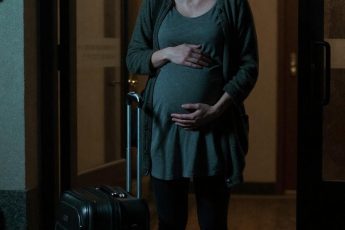
As passengers disembarked, Javier waited. When Lucía appeared, hand in hand with Sofía, pulling a threadbare suitcase behind her, he stepped forward breathlessly.
“Please, wait,” he said, urgency breaking through his polished exterior.
Lucía froze, instinctively shielding her daughter. “Sir, we need to go. The baby’s fine now.”
“It’s not just that,” Javier said earnestly. “You have something my son—and I—desperately need. Something I don’t.”
Amid the chaos of Villa del Sol airport, Javier offered the most astonishing proposal of Lucía’s life. He asked her to become Mateo’s primary caregiver—not merely a nanny, but an irreplaceable part of their fragile family. He promised a salary higher than she could earn in years of cleaning, a place to live in his sprawling home, stability for both her and Sofía.
Lucía eyed him cautiously, hardened by life’s disappointments. ‘Sir, I have a daughter. I can’t just move into a stranger’s house.’
“Bring her,” Javier insisted. “My house in El Encinar is enormous—too vast for just the two of us. One month’s trial. If you’re not comfortable, I’ll pay three months’ salary, and you can leave. But Mateo…” His voice cracked with desperation. “He needs you.”
Lucía glanced at Sofía, who watched Mateo sleeping in his luxurious stroller with wide, curious eyes. She thought of the cramped boarding house waiting for them, the daily uncertainties gnawing at her courage. Then she looked back at Javier, at the raw honesty etched into his desperate plea—and she said yes.
Arriving at Javier’s mansion in El Encinar was like entering another world. The house was a masterpiece of sleek glass, polished steel, and pristine white marble—stunning yet sterile, as if it revered perfection but shunned life. No scattered toys. No worn family photos. It was a mausoleum guarding a flawless existence long hollowed out by grief.
The first days were uneasy. Lucía felt like an outsider within those pristine walls. But, just as on the plane, a quiet magic began to blossom. Lucía didn’t simply care for Mateo—she breathed life back into the house. She opened curtains long shut, inviting dappled sunlight that had been absent too long. The kitchen—once silent—now whispered its own stories with the scent of sofrito, spices, and simmering stews.
Sofía, with all the innocence and joy of her two years, became the spark everyone needed. To her, Javier was not the untouchable CEO but simply “the tall man.” One afternoon, while Javier struggled to focus in his office, Sofía burst in chasing a bright, bouncing ball. She paused at his desk, eyes wide with hope.
“Want to play?” she asked, holding it out innocently.
Something inside Javier cracked. He looked from the ball to the little girl, and then slowly, he abandoned his ivory tower. Sitting down on the Persian rug, he rolled the ball back to her.
That moment shifted everything.
Months passed, and the mansion blossomed into a home. Toys spilled across the sleek living room floors. Laughter echoed through the hallways. And something deeper had taken root: a family woven without the ties of blood.
Javier found himself leaving the office earlier. Deals and mergers lost their urgent glow; bathtime for Mateo became the highlight of his day. He watched Lucía with a new focus, absorbing lessons beyond spreadsheets—how to hold a son gently, how to decode his sounds, how to surrender fear and simply love. And as he learned to be a father, he found himself falling for the woman who taught him everything.
It wasn’t a fiery romance born of instant attraction. No sizzling cinematic love. It was slow and steady, like the aromatic stews simmering on their stove. He admired Lucía’s resilience, the way she tied back her hair when concentrating, the equal devotion she showered on Sofía and Mateo alike. He fell deeply for the woman who had saved his son and, without knowing, saved him.
Lucía, in turn, saw Javier’s defenses crumble. Behind the tailored suits was a gentleness few ever glimpsed—the tenderness reserved for moments when he thought no one was watching.
Nearly a year after that turbulent flight, they sat together in the garden beneath a blanket of dry autumn leaves. Sofía and Mateo, now crawling and curious, played among the swirling gold. A peaceful silence wrapped them like a shared secret.
“The contract is over,” Javier said softly.
Lucía’s heart fluttered, emotions a tangled web. “Yes… I suppose I should start looking for an apartment,” she replied, fighting to keep calm.
Javier reached for her hand, their fingers weaving naturally together. “No,” he murmured. “The nanny contract ends because I don’t want you to be my employee anymore. Lucía, this house was lifeless before you arrived. So was I. You brought us back.”
Taking a steady breath, he dropped all pretense. “I don’t want you to leave. I want this to be our life, not work. I love you, Lucía. And I think… Mateo and Sofía are already siblings—every way but on paper.”
Tears slid down Lucía’s cheeks—not of grief, but of long-postponed joy. “I love you too, Javier.”
Their kiss was neither passionate nor hurried. It was a kiss of homecoming—a harbor after a storm. It sealed a promise quietly woven at 30,000 feet, amid despair and hope.
Two years later, sunlight bathed a quiet courtroom. The magistrate, an elderly man with thoughtful eyes, smiled as he examined the papers. “Cases like this are rare,” he said, removing his glasses. “Usually, here we witness conflict and separation. But this… this is the birth of something new.”
Javier signed the adoption papers for Sofía. Lucía signed Mateo’s. Ink sealed what their hearts had known all along.
As they stepped into the bright afternoon, Mateo—now toddling, words tumbling freely—grabbed Javier’s hand. “Dad, look!” he exclaimed, pointing at an airplane streaking across Madrid’s blue sky.
Javier followed his son’s gaze, gripping his hand tightly, arms winding protectively around Lucía’s shoulders. A slow smile spread across his face as he remembered that fraught day—the screaming, the fear, the helplessness. He thought about life’s strange gifts, hidden deep inside impossible trials.
“Yes, son,” he said, eyes meeting Lucía’s with boundless love. “It’s an airplane… that’s where our real story began.”
The Romero family’s tale traveled far—not because of fortune or fame, but because it proved family isn’t defined by blood, but by those who stay when the tears won’t stop. They showed that true love arrives when you’re brave enough to need help—and generous enough to give it, even to a stranger.
Because in the end, the strongest ties are stitched not by DNA, but by hearts choosing one another, every single day.