My name is Noah. I’m 34 years old, and throughout my life, I’ve been the steady pulse of our family — the dependable one. Not the adored favorite, not the defiant rebel, not the shining star, but the one who always showed up, paid my own way, and marked every birthday on the calendar. I work in finance, live alone in a quiet apartment, and have built my existence on disciplined restraint and quiet reliability. Meanwhile, my family? They’re a vibrant circus — loud, tightly knit in that meticulously choreographed way families tend to be, brilliant at plastering smiles over cracks and hushed tensions.
I’ve always felt a little like a shadow at the edges, involved but never fully embraced. The guy they invite to weddings but never bother to include in the pictures. My younger brother, Logan, has always been the sun around which the family orbits. Charismatic, wild-eyed, perpetually tumbling headfirst into chaos and somehow emerging grinning, unscathed. His reckless charm was their sweet addiction. When Logan dropped out of college, they hailed it as his quest for self-discovery. When he flamed out of jobs like candles in the wind, they excused it as corporate worlds unable to contain his creativity. Now in his late twenties, back under their roof, he was a prodigal son rather than a man-child ducking responsibility.
Me? I’d put myself through college alone, kept the same tough job for over a decade, quietly helped with the mortgage when Dad’s hours got cut five years ago. Yet none of it ever seemed to hold the same weight as Logan’s so-called potential. I was the unshakable scaffolding that held the family’s messy facade, while Logan was the dazzling, unpredictable marquee everyone admired.
I told myself I was okay with this. Mostly, I kept my head down, sent checks, replied to the endless family group texts, and showed up for holidays, smiling and swallowing the jabs that always came cloaked as jokes: “Noah, you’re too serious! Chill out, man.” “Oh, we figured you’d be busy, Noah, always working.” I bore it, hope quietly nesting inside me that maybe, just maybe, year after year of showing up would finally earn me the genuine belonging I craved.
That fragile hope shattered last fall. It began, as these things often do, with dinner. Logan had just gotten engaged to Claire, a woman Mom already called “an absolute angel.” My parents decided to celebrate with a lavish dinner at the Skyline Veranda — an upscale rooftop restaurant far beyond their usual reach. That, in hindsight, should have been my first red flag.
Weeks before, Mom called me with that sweet, syrupy tone she reserves for when she’s angling for favors. “Noah, sweetheart,” she said. “We’d be over the moon if you could come to Logan and Claire’s engagement dinner. It’s going to be unforgettable.”
“Absolutely,” I replied. “Just send me the details.”
Then she dropped it, almost a whisper: “And… if it’s not too much trouble, would you mind holding the reservation with your card? The restaurant wants one on file. We’ll pay you back, of course.”
I should have recognized that phrase as fairy dust—‘we’ll pay you back’—but like the fool I was, I agreed. I called the Skyline Veranda, reserved a private section for twenty, gave them my credit card for the $500 non-refundable deposit. No big deal. It was Logan’s moment, after all. Maybe this time, I’d finally feel like I belonged.
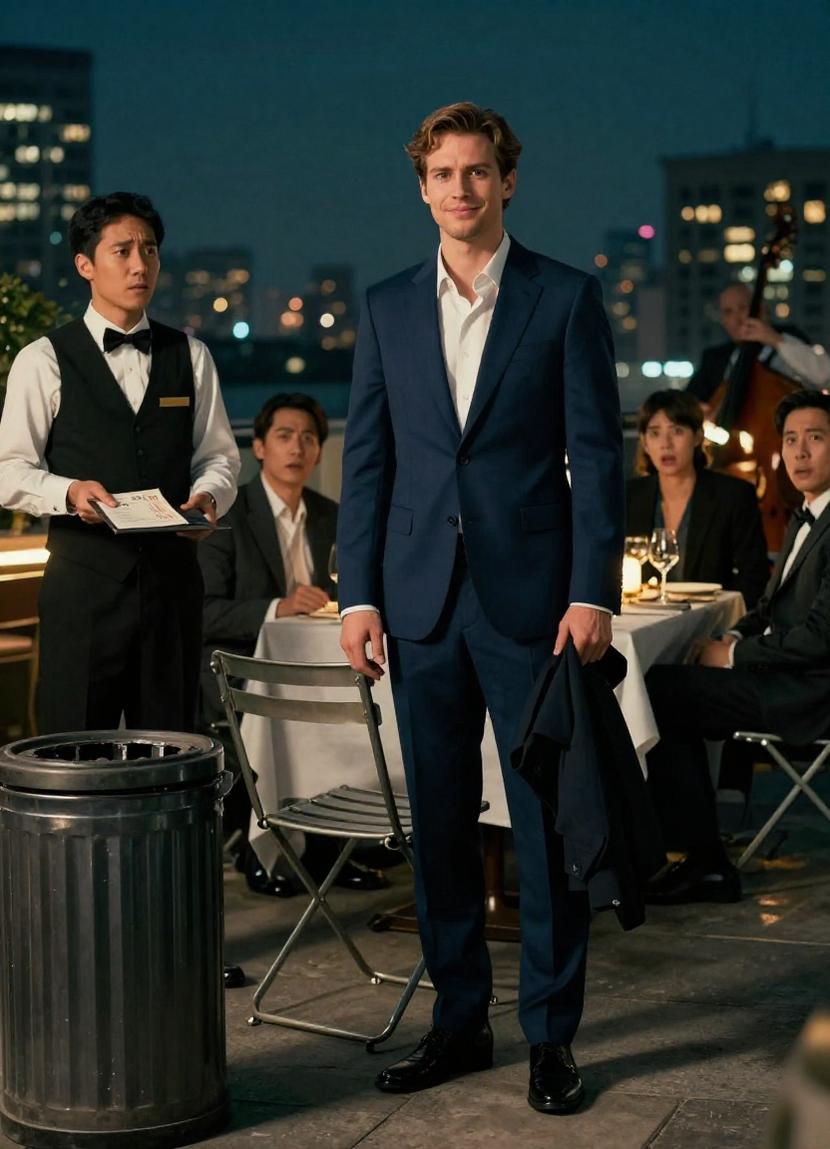
The night arrived. At 7:00 PM sharp, I stepped onto the rooftop, crisp navy suit, freshly ironed shirt, new cufflinks glinting in the soft light. I carried a nice bottle of champagne and a custom card embossed with their initials. The hostess showed me to the private area, awash in warm string lights and fragrant floral centerpieces, the air humming with soft jazz.
There they all were—Mom, Dad, Logan, Claire, her parents, their friends—laughing, clinking glasses.
I smiled, edging toward the main table, expecting at least a nod.
But Logan smirked, barely glancing at the champagne. ‘Hey,’ he said, his voice thick with condescension. Then he pointed.
There, wedged awkwardly between a large potted plant and a dumpster, sat a solitary metal folding chair.
“Sorry, man,” Logan said mock-sympathetic, “this table’s only for family. Your spot’s over there.”
I blinked, stunned. Surely a cruel joke? I looked to Mom for backup. Her smile was tight, a practiced neutrality. Dad raised a glass in a silent cheer. Claire didn’t even look up. Their friends laughed—actually laughed.
The champagne bottle suddenly felt like a weighty stone in my hand. I wanted to scream, to confront, but my throat seized. I was that thirteen-year-old left out of the group photo at a cousin’s wedding because my braces didn’t “fit the vibe.”
So I swallowed my pride, set the bottle on the floor, and sat on the folding chair. Alone. Coat on, silent.
A waiter came by, asked if I was with the party. I nodded wordlessly. He offered a glass of water and moved on.
Two hours, I sat in ghostly silence. Watched toasts, laughter, gift openings. Watched Logan gush about his “closest people,” “his real family.” Watched Mom tear up when Claire called her the best future mother-in-law. No one asked if I wanted a drink.
Dessert arrived. An extravagant cake blanketed in edible gold flakes. The sun slipped behind the Everwood skyline, painting clouds in fiery orange and soft purple. And it hit me – not one glance, no acknowledgment for thirty minutes. I was a ghost at my own brother’s celebration.
Then came the bill.
The waiter approached the main table with the check folder. Paused, glanced at the total, then flicked a look toward my card on file. $3,218.
He hesitated, then stepped toward me.
“Sir,” he said quietly, the professionalism in his voice stark against my family’s coldness, “shall I run this card for the final amount?”
Every head turned to me. The jazz faded to a haunting silence. Logan raised an eyebrow, amused.
“Oh yeah,” he said with a wave, “Noah’s covering it.”
The waiter looked expectantly at me.
I smiled – slow, calm, precise, the smile that didn’t quite touch my eyes.
“Not my table,” I said just loud enough for all to hear. “Logan said this table’s for family only.”
Silence crashed down like shattered glass. Logan’s mouth parted, clueless. Mom frowned, caught off guard. Dad straightened, unsettled. Mr. Henderson’s brow furrowed deeply.
The waiter clutched the bill like it was radioactive. “Sir… you made the reservation.”
“I did,” I nodded. “And I paid the deposit. But as you can see, I’m not with them. I’m over here.” I stood, grabbed my coat, gestured toward the trash bin. “Apparently, that’s where I belong.”
The collective intake of breath was deafening. The waiter looked ready to vanish. Logan looked like he’d been slapped with a wet fish. Mom’s eyes narrowed, darting between me and the bill, scrambling to regain control.
“Wait, Noah,” she whispered, shaky, “what are you doing?”
I shrugged. “Following the seating chart, Mom. Logan said the table was for family only. I took that to mean I wasn’t included in the bill either.” I faced the waiter. “I didn’t eat. Didn’t drink. Wasn’t welcome. So I won’t be paying.”
“Don’t be ridiculous,” Logan snapped, losing his mask. “It was a joke. Lighten up. You always take things too seriously.”
“Yeah,” I said slowly. “That’s the problem. You think everything’s a joke as long as the punchline is someone else’s pain.”
Mr. Henderson gave Logan an icy look. “You invited this man to your engagement and sat him next to the trash?”
Mom hurried in, trying to stem the tide. “Let’s not blow this out of proportion. Noah’s being dramatic. He’s always been too sensitive.”
That tired line, the eternal dismissal of my pain as weakness, made me want to laugh bitterly.
“Sorry to interrupt,” the waiter said, voice strained, “but we need to settle the bill.”
I turned toward the stairs, ready to leave.
Dad’s gruff voice stopped me. “Come on, Noah. You already paid for half. Might as well finish it.”
I froze. The phrase “might as well” cracked something inside me.
I faced them all, voice low but fierce. “I did pay the deposit. I called three places to find a rooftop like Logan wanted. I ordered custom flowers because Mom said fakes looked cheap. Paid $500 non-refundable without hesitation. Showed up on time, in a suit, to support my brother.”
I took a step closer, eyes locked on Logan’s flushed face. “And for what? A folding chair by a garbage bin and ‘family only.’ Now it’s your mess to fix. You and your real family.”
Logan sputtered, “You’re making a scene.”
“No,” I said, “I’m drawing a line.” And I walked away, taking the stairs, each pounding step a gale of adrenaline and liberation.
The fallout hit before I reached home. Mason texted: ‘Dude, really? Couldn’t just pay and talk later?’ Mom messaged: ‘You embarrassed us with Claire’s family. Was that your goal? Revenge?’
Then an unfamiliar number called.
Claire. Her voice softer than I’d ever heard. “Hi, Noah. I know we don’t talk much, but… can I ask something?”
“Sure.”
“Did you really pay for everything? Deposit, flowers, all of it?”
“Yeah.”
A pause. “They told my dad you offered. That it was your gift.”
That stopped me. “I never offered. They asked, I agreed. Didn’t expect thanks, and certainly not showmanship.”
She sighed. “My dad’s furious. Says he never would have agreed to the expensive venue if he’d known the people he was humiliating were paying. He said your family made a fool of him.”
In the days after, the family chat exploded with fake concern. Meanwhile, Mr. Henderson lost his temper entirely — calling Claire, seething at being made a pawn in their charade. “If this is how they treat their own,” he said, “what will happen when you marry in?”
Logan took the hit like a freight train. Wedding plans froze. Claire retreated to her condo “to reset.” Mom launched into full damage-control mode, sending me a multi-paragraph, guilt-laden email titled simply: ‘Please.’ Not once did she say sorry.
Then, Aunt Lisa called. “I heard about the dinner,” she said with a dry, approving tone. “Good. It’s time someone shook the tree.” She told me Mom had begged her to “talk sense” into me. “I told her you don’t need sense. You need space. And for them to stop using you as their scaffolding.” Her words felt like a balm — the first time I felt truly seen in this family.
Later, Logan texted nervously: ‘Bro, Claire’s dad canceled the wedding deposit. Said we don’t share values. You have to fix this.’
He still didn’t get it. So I fixed things — on my terms. Quietly, I moved the last funds from a joint account I’d set up for him when he was jobless — money he used for Spotify, the gym — into a new private savings account. Then I closed the joint credit line.
The next morning, frantic: “What did you do? My card’s declined! Account doesn’t exist!”
“I closed it.”
“You can’t!”
“I can. You told me I wasn’t family, remember? You don’t get to use my money if I’m not even allowed at the table.”
He spat the last card. “You’re just jealous I got the attention.”
I laughed, genuine and free. “Don’t worry, man. You always figure something out.” Then I hung up.
Hours later, Claire emailed. Subject: I think we need to talk.
She said the dinner had pierced the veil she’d worn for Logan’s antics. He lied, claiming I insisted on paying and chose to be alone because I’m shy. She called the restaurant, heard the truth from the manager.
‘I ended the engagement last night,’ she wrote — words burning across the screen. ‘I’m not dragging you into drama. Just wanted you to know I see now. I’m sorry it took this long.’ I sat, rereading the words, stunned — not disbelief, but disbelief that someone finally saw me.
Weeks passed. Logan moved back home. Claire returned the ring. The perfect family facade crumbled.
One Sunday, Mom knocked, holding lasagna like a peace offering. Her eyes red, confidence stripped.
“I brought dinner,” she said softly. I didn’t reach for it.
“I just wanted to talk. No excuses.” Surprised, I let her in.
She sat at my kitchen table, hands twisted, voice raw. “I owe you an apology. Not for not seeing it, but for not wanting to. Logan’s loud, takes all the space. You… you never asked for anything. You just did. We treated you like a safety net, assuming you’d always be there.”
“That’s the thing about safety nets,” I said quietly, “people only look at them when they’re falling.”
Her lip trembled. “Your father and I were wrong. We let Logan get away with too much. We let him treat you like less.” Looking me in the eye, she said, “A lasagna won’t fix years of imbalance. But I see it now. I’m so, so sorry.”
For the first time, she didn’t dodge or deflect. She sat there, owning it. I nodded slowly. “Thank you.”
Nothing magically healed overnight, but things stopped worsening. My parents started sending brief, respectful messages. Mom invited me to Thanksgiving, adding, “only if you feel up to it.” I haven’t decided. Logan’s back working part-time, living rent-free. No word from him, and I’m okay with that.
As for me, I finally took that long-postponed trip to Spain. I read books on boundaries. Began therapy — not because I was broken, but because healing doesn’t come from waiting for apologies. It starts when you face your reflection and say, “I deserved better. And now, I’m giving it to myself.”
So no, I didn’t pay that bill. But I finally collected on years of silent debt. For the first time, I’m not sitting next to the trash can. I’m at my own table — where there’s always room for me.