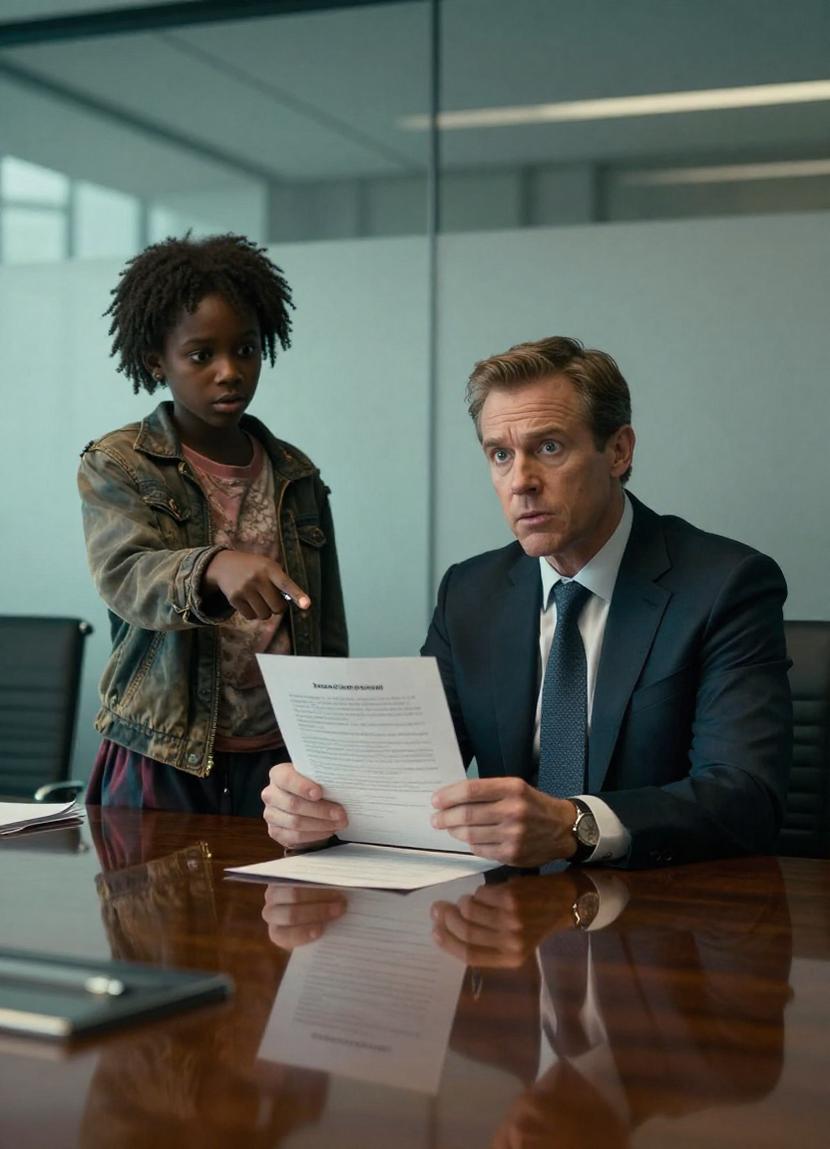
Julian Cross’s hand trembled so violently that the pen tip wavered uncertainly above the signature line, as if his very body sensed the cataclysm that single stroke could unleash. The conference room’s glossy table reflected his immaculate suit, a sharp contrast to the sweat tracing a cold trail down his temple and the desperate tightness in his throat that refused to let him swallow. Around him, stiff-faced lawyers sat mute and tense, their eyes locked on the bankruptcy documents like pallbearers about to lower a coffin.
Then, a fragile voice cut through the heavy silence.
“Sir… please don’t sign that.”
Every head snapped toward the sound.
By the glass wall stood a girl no older than twelve, her threadbare jacket inadequate against the storm raging outside and her worn shoes barely holding together. She had been allowed in only because the downpour had rendered the lobby unpassable—and because she’d quietly helped others hold doors open, unnoticed and unassuming.
But now, her gaze was locked on the papers in Julian’s hand.
“There’s a mistake,” she said, her voice barely above a whisper but piercing through the room like a bell. “A big one.”
The lead attorney jerked upright, chair scraping harshly on the floor. “This is a private meeting. She needs to leave immediately.”
Julian raised a steady hand.
“Wait.”
For the first time in weeks, courage replaced fear in the room.
He studied her closely. “What kind of mistake?”
Nia Mensah stepped forward, uncertainty flickering across her face. Then, steadying herself, she pointed to a line on the page.
“That clause—you know, the one about the Silverstrand Harbor acquisition? It says the entire debt transfers immediately. But only sixty percent should be shifted in the first five years. The rest hasn’t matured yet.”
Silence slammed into the room like a physical force.
Julian’s eyes dropped to Clause 17C.
He had pored over it countless times; every attorney there, too. Yet suddenly, his heartbeat thundered through his ears.
“Stop,” he ordered, voice low but commanding. “Review that clause again. Now.”
The lawyers exchanged sharp, irritated glances but obeyed.
Minutes crawled by.
Finally, one swallowed hard. “…She’s right.”
The air shifted—thick with shock and reluctant awe.
“That portion of the debt can’t legally be counted yet,” the attorney admitted reluctantly. “Our liabilities have been grossly overstated.”
Julian drew a long breath, his lungs finally able to expand fully.
“Find her,” he said sharply. “Bring her back.”
Nia Mensah’s story was etched in resilience. Homeless since fourteen, after her mother’s passing left her alone and the crushing burden of rent scattering whatever stability they’d had, she slept in subway stations and church shelters, scavenging cans by day. Yet numbers spoke clearly to her—a language her mother, an accountant, had once taught her.
“Numbers don’t lie,” her mother used to say. “People do.”
Nia had studied accounting briefly in school, enough to see the unseen threads, to recognize patterns, and sense when something was amiss.
That stormy day, she hadn’t meant to read those documents.
But once she caught sight of that one line, she couldn’t look away.
Three days later, Nia sat not near the exit, but confidently beside Julian Cross in a sleek conference room at Crosswood Freight Solutions.
“Speak freely. Tell me everything you see,” Julian urged.
She did.
Misclassified liabilities. Inflated losses twisted beyond reality. Debts accelerated on paper, painting a false picture of collapse that should never have been.
A damning pattern emerged.
It wasn’t just mismanagement—it was manipulation.
Victor Ames, the company’s CFO, left abruptly before the meeting ended.
Two weeks later, an independent audit vindicated them all.
Money had been siphoned off through phantom vendors, losses disguised as routine expenses. Numbers bent just enough to hide betrayal.
Victor Ames was immediately suspended pending a full investigation.
Six months on, Crosswood Freight Solutions not only survived but transformed completely.
Transparency became non-negotiable, oversight the new backbone.
Nia returned to school on a full scholarship from an unnamed foundation funded quietly by Julian.
She also returned to the company—this time as a junior financial consultant.
On her first day, Julian said softly, “This company wasn’t saved by money. It was saved by someone who dared to speak up when silence seemed safest.”
She smiled—small, steady, unbreakable.
The true lesson echoed beyond the boardroom walls:
The world didn’t shift because a billionaire escaped bankruptcy.
It shifted because a homeless girl noticed the one line no one else saw.
Because intelligence needs no title.
Because truth asks for no permission.
Because silence is never truly the safest choice.
Sometimes, the most powerful chapter in your life is written by the voice you never expected to hear.