Elena Ramirez’s obsession with children was unlike anything I had ever seen—a relentless, consuming fire that shaped every corner of my childhood. From the tender age of eight, my sister Luciana and I were trapped in her twisted vision of motherhood. She forced us to wear grotesque, sand-filled pregnancy simulation suits weighing twenty pounds, strapped tightly against our small bellies, for hours on end every day. We were made to breathe deeply, practicing Lamaze techniques while twisted birthing videos played relentlessly. If we dared to complain about the sharp, stabbing back pain, Elena only tightened the suits further and spat, “Real mothers don’t whine.” Play became a forgotten memory, replaced by this grueling “maternal training.”
The nightmare went further: gummy, android-like dolls that screamed if held wrong forced us into faux breastfeeding sessions. While I constantly dreamed of escape, Luciana seemed to drink in the cruelty as if it were her lifeblood, waddling around the house proudly, hands cradling her fake belly, whispering coos like a preacher at a pulpit. By sixteen, she pleaded to be a “practice surrogate” for one of Elena’s infertile coworkers—a role Elena embraced with almost reverential pride.
Luciana’s eighteenth birthday wasn’t marked with typical celebrations; instead, Elena threw a grand party to herald Luciana’s signing of her first surrogacy contract. Friends and relatives gushed over Luciana as a “blessing” and “angel,” while I sat in a shadowed corner, feeling like an auction spectator as my sister was paraded like prized livestock.
Within three turbulent years, Luciana carried three babies for different families—each time she returned home, hollow-eyed and physically diminished, Elena would flaunt her as a war hero, a goddess of sacrifice. “Look at my generous daughter,” she’d boast with a wicked pride that sent chills down my spine. Meanwhile, I was chasing a biomedical degree and immersing myself in women’s rights, bodily autonomy, and medical ethics. None of it mattered to Elena. To her, I was “hoarding my fertility” while Luciana was offering “gifts of life.”
The true horror emerged as I watched Luciana’s body unravel after her fourth pregnancy at twenty-two—her hips shattered, infections relentless, hair falling in clumps. When I reached out to her, trembling with fear for her health, Luciana gripped my hands tightly, eyes aflame with a feverish zeal. “Isabela,” she whispered, tears streaking down her face, “this is why I exist. My body is a vessel for miracles. Why won’t you see that?” That was when the last slivers of my sister faded, replaced by a shadow shaped by our mother.
I learned to survive by pretending—putting on a brittle mask of compliance, telling Elena I was “considering” pregnancy, dressing to suggest fertility, leaving my laptop open on fertility clinic websites just for her to see. Secretly, I was assembling a different future, studying for the LSAT and applying to law schools nationwide. I eventually specialized in reproductive rights and medical ethics, fighting for women trapped in chains like those Elena forged. By twenty-eight, I was a partner in a respected law firm, fighting battles far from the suffocating walls of my childhood.
Then came the so-called “celebration dinner” Elena invited me to for Luciana. I braced for another pregnancy announcement. Instead, it was an ambush—an intervention wrapped in poison. We sat at a stark, long table: Elena, heavy with her insidious glee; pregnant Luciana, radiant with twisted pride; and me, the captive.
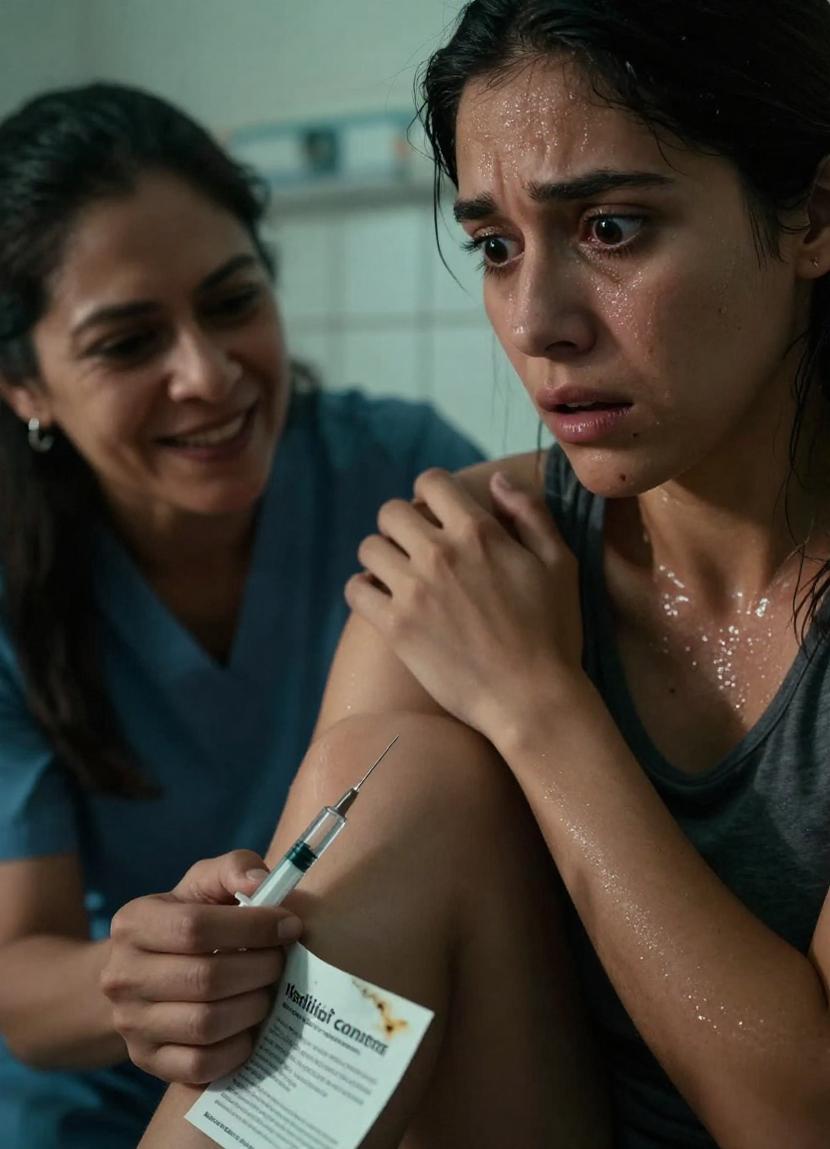
“Sweetheart, you’re not getting any younger,” Elena teased, syrup dripping from her voice as she pulled a syringe from her purse. “So, I’ve taken it upon myself to start your fertility treatments.” Before I could react, she advanced with the needle, a chill of betrayal shooting through me. Luciana, unnervingly strong, pinned my arms, whispering, ‘Please, Isabela, just try it. I’ve found the perfect family for your first child.’ I fought with every ounce of strength, but they were prepared. Syringes lined the side table, silent weapons in their scheme. The prick was sharp, cold liquid flooding my thigh, agony erupting in my belly as my vision blurred. Through the haze, I heard Elena coldly report over the phone, “We’ve started the protocol. She’ll be ready for harvest in two weeks.” This monstrous plan wasn’t just family pressure—it was trafficking.
I awoke in the sterile silence of an ICU, white tiles glaring down, dull agony pulsing through my pelvis. Ovarian Hyperstimulation Syndrome had almost cost me my womb. Elena stood over me—not with concern, but harsh disdain. “We only brought you here to save your uterus,” she declared, her voice void of warmth.
I pressed the nurse call button. The nurse who arrived, a kind woman with weary eyes, took one look at Elena’s commanding posture and gently but firmly removed her from the room for a private examination. Alone, the nurse’s exhaustion crumbled as she embraced me softly, whispered, “Are you okay?” I cried, spilling the full horror—the surrogacy nightmare, the favoritism, the forced injection. Her shock turned to fierce resolve. Together, we would make Elena pay.
Minutes later, she returned with Detective Herrera of the domestic violence unit, a man versed in cases of reproductive coercion. Elena, trying to slip past a secure door, caught my eye and mouthed a venomous “Ungrateful bitch.” Meanwhile, my phone buzzed frantically—Luciana. “How could you call the police? Mom was HELPING you! You’re destroying our family!”
Detective Herrera was grim. “This isn’t our first report about forced fertility treatments,” he said. “There is a disturbing pattern involving certain clinics.” Then came the gut punch: “Does your mother work in the medical field?”
“She’s a receptionist at Serene Horizons Fertility Center,” I whispered, the weight crashing down.
A hospital social worker arrived, visibly shaken. Seeing my name and Elena’s connection, she stammered, avoiding my gaze and clutching her clipboard like a lifeline. Elena’s reach stretched deep. On a desperate check of my medical portal, I found a forged medical power of attorney, signed over to Elena three months earlier.
Then, an expensive-suited man entered, representing Elena. “Maria Ramirez is clearly suffering hormone-induced psychosis,” he claimed, demanding immediate psychiatric evaluation. Trapped in her web, my protests were twisted into symptoms. Even my law firm, contacted by Elena, urged me to “get better.” Through the window, I saw Elena wield my keys, rehearsing my schedule—her years of plotting unraveled before me.
The psychiatric evaluation was a cruel sham. Dr. Marquez, Elena’s book club ally, ensnared me in trap after trap. My career? A “projection of internal conflict.” The baby dolls found in my closet? “Proof of fertility grief.” She ordered a 72-hour hold, the machinery of control grinding inexorably.
As they prepared my transfer, a kind nurse slipped me a scrap of paper—a phone number. “There are more of us than you think,” she whispered. “Women who know what Serene Horizons hides, who’ve been too afraid until now.”
The psychiatric ward was a cold cage: a thin bed with restraints, a window looking out but never freedom. That afternoon, Elena arrived, suitcase in hand. She unpacked maternity clothes, prenatal vitamins, and a journal titled “My Fertility Journey,” its first pages eerily inscribed in my handwriting.
“The egg retrieval is next week,” she said casually. “Dr. Navarro at Serene Horizons is optimistic about your eggs.” I refused, but she smiled softly. “Not your choice—not yet. I’ve petitioned for temporary medical conservatorship. Until you’re ‘clear-headed.’” A sentence to surrender all control.
That night, another nurse, friend to the first, slipped me a second phone number—hope encoded in digits.
I realized I had to fight their system by becoming the prisoner they expected, pretending madness to prove sanity. The next day, in group therapy, I faltered as I fabricated dreams of holding a baby, confessed jealousy of Luciana, soaked in “fertility grief.” I let Elena dress me in those maternity clothes, murmuring how “natural” it felt, playing my role.
Dr. Marquez hailed my “breakthrough,” recommending immediate release. Elena beamed, scheduling my visit to Serene Horizons the same day as the conservatorship hearing.
Released the next morning, Elena waiting, I convinced her to let me change at my apartment first. Once inside, I locked myself in the bathroom and made a desperate call to a colleague. “The hearing’s at 2 p.m. I won’t make it—the clinic’s schedule conflicts. Check my email; everything is under ‘PERSONAL.’”
At Serene Horizons, 1:30 p.m., I slipped away at 2:15, escaping to a ride-share. Bursting into the courtroom at 2:25, my colleague looked at me with relieved triumph; Elena’s color drained.
“Your Honor,” I declared with clarity and fire, “I am here on my own free will. I contest this conservatorship.”
The hour that followed was brutal. Elena’s lawyer wielded Dr. Marquez’s evaluation like a weapon, painting me unstable. But my colleague countered fiercely with forged documents, timelines of manipulation, and sworn testimony from the nurse fired for helping me. This brave woman had linked me to a network of women victimized by Serene Horizons, waiting for their moment.
“Your Honor,” I said, voice steady, “this isn’t fertility grief. It’s a mother’s madness—a woman who built her identity on her daughters’ wombs. She drugged, forged, and destroyed me because I refused to join her breeding machine.”
The judge, a stern woman with sharp eyes, weighed the evidence carefully. Hair follicle tests confirmed drugging. The petition was denied. More powerfully, she issued a permanent restraining order: Elena Ramirez must have no contact with me.
Elena’s wails filled the courtroom, her lawyer whispering desperately, but the verdict was final.
Outside, in the parking lot, I saw Luciana staggering from her minivan, her body ravaged by her sixth pregnancy. Surrounded by her five children, she called weakly, “How could you? Mom loves us!”
I didn’t stop. “She loves what our bodies can give her,” I said. “There’s a difference.”
The storm that followed exposed Serene Horizons and Dr. Navarro. Complaints, testimonies, and investigations revealed a criminal web of coercion, malpractice, and fraud. The clinic shuttered, licenses revoked, and Elena faced civil suits and possible criminal charges.
My law firm embraced me with open arms, partners shaken by the depths of what I had endured. Lucas, my boyfriend, who had been manipulated by Luciana with false texts about my “baby fever,” learned the truth—his trust shattered, but healing began.
Luciana’s sixth birth was near fatal. Doctors warned any more pregnancies could claim her life. I should have felt victory, but sorrow drowned me—for my sister, a victim as much as I was.
Months later, an unknown call: my niece Sofia’s voice, small and fragile. “Aunt Isabela? Mommy’s sick… Grandma talks about when I can have babies. I don’t want to be like Mommy.”
My heart fractured and soared. “You don’t have to be, Sofia,” I promised. “You can choose your own path.”
“Can I visit you?” she asked quietly. “Mom says you’re dangerous, but you don’t seem that way.”
“I’d love that,” I said softly.
The battle isn’t over—it never truly ends when family is involved. But victories have been claimed, boundaries drawn. Somewhere, a little girl is learning she’s worth more than what her body can yield. And that truth—that hope—is everything.