A sharp tang of lemon polish and the ghost of unfulfilled dreams clung stubbornly to Isela Navarro, wrapping around her like a second skin. It wasn’t perfume. It was the lingering evidence of Mateo Navarro’s labor—a subtle, persistent shadow marking her every step. At Hawthorne Heights Academy, where every locker shone under fluorescent lights and designer blazers whispered privilege through the halls, Isela stood out like a secret scratched onto a polished surface. Her uniform, clean but ill-fitting, was a quiet testament to the countless hours she’d devoted to helping her father clean the very floors that echoed with the disdain of her peers. Each morning, as Mateo slipped silently out to start his day, Isela’s eyes followed him with a silent plea—for a world where his weary shoulders were not targets, where the cruel whispers lost their teeth.
Mateo, with his perpetually tired eyes and knotted hands hardened by years of scrubbing, was invisible to most. To the students, he was just the janitor, a shadow moving through corridors, appearing only long enough to empty bins or mop spills, dismissed and overlooked. But to Isela, he was her fortress, her steady giant humming old folk songs as he repaired her worn shoes. Under his quiet guidance, she learned the pride of honest work—even if such dignity seemed a luxury too costly in the ruthless currents of Hawthorne Heights.
The whispers were venom, slipping past her defenses in the cafeteria, haunting her answers in class, growing louder in the locker rooms: “Janitor’s daughter.” Those three words landed like daggers, stealing her voice, unspooling her confidence, closing her throat to hunger. Vanessa Quinn, the queen bee with her unyielding stare and sharp blonde edges, made sport of Isela’s suffering. To Vanessa, Isela was not just an outcast—she was a living chasm that needed widening, a reminder of everything the social ladder refused to tolerate.
“Honestly,” Vanessa once sneered loud enough to slice through Isela’s resolve, “some folks just don’t know their place.” The words twisted tight inside Isela, a clash of burning shame and defiant courage.
One crisp autumn morning, a fresh notice took its place on the bulletin board: the annual Hawthorne Science Fair, with a grand prize that shimmered like a distant sun—a scholarship to Willowbrook University. It was more than a prize. It was a lifeline, a promise of escape from the labels, a chance to rebirth herself beyond the shadow of the janitor’s daughter. Her heart sparked with quiet hope, across the cold divide of the school’s hierarchy. Science was her haven—a world measured not by bloodlines, but by ideas, by discovery.
She labored deep into the night, her fingers following the contours of dusty textbooks, driven by silent desperation. Her project was ambitious: a water purification system forged from natural, accessible materials—a nod to Mateo’s resourcefulness and a blueprint for hope. She envisioned small villages with murky wells, children drinking clean water, and for a brief flicker, the oppressive world of Hawthorne lifted from her shoulders.
As the days edged closer to the fair, Isela found refuge in the empty science labs. Mateo was there, just beyond her reach yet undeniably present—a steady calm. He would offer lukewarm tea in a chipped mug, his eyes crinkling in quiet pride. Yet, beneath this simple routine, puzzles hovered. Mateo’s old flip phone buzzed with low, urgent voices—discussions of “allocations” and “fund disbursements” that betrayed his humble facade. The antique pocket watch clasped to his wrist, worn smooth and gleaming far beyond a janitor’s means, marked hours with almost reverent care. Even some seasoned teachers nodded with deference or inquired after his family’s health in strangely formal tones—breadcrumbs Isela had barely pieced together, distracted by the daily sting of her own battles.
But Vanessa, with her sharp entourage, shattered this fragile sanctuary one afternoon. Their laughter cut through the hush of lab equipment as they barged in.
“Look who’s here,” Vanessa drawled, dripping with mockery. “Playing scientist, are we? Or just cleaning Daddy’s mess?” Her words ricocheted against glass beakers, stabbing at Isela’s already frayed nerves. Her friends’ cruel giggles followed like a chorus of shadows.
Isela’s cheeks flamed with humiliation. Her hands gripped a beaker, knuckles whitening. She wanted to scream, to shout her truth, to demand respect—but years of rendered silence had sealed her throat tight. Her gaze flickered to Vanessa’s manicured nails and that victorious smirk.
“Leave her alone, Vanessa,” came a voice low and sure—that of Ethan, the school’s brilliant star, a rare light unclouded by social politics. Rarely speaking, his words carried unexpected weight. Vanessa’s eyes blazed with venom for a moment, then she tossed her head and swept out; her flock followed obediently, the lab left haunted and hollow.
Isela’s eyes met Ethan’s—there was something there, perhaps understanding or pity—before he returned to his own complex project. The moment left Isela shaken, humiliation still bruising her skin, yet tempered by a steel-hard resolve. This scholarship—she would win it for Mateo, for every whispered slight, for every scar left by cruelty.
The Hawthorne Heights auditorium thrummed with anticipation as stage lights bore down. Isela stood beside her intricate purification device, heart pounding with nerves and determined fire. Taking a breath scented with antiseptic and her own sweat, she began.
Her presentation was a symphony of passion and precision. She spoke of science and humanity—of water bringing dignity and life to those forgotten by privilege. Her voice, usually soft, now rang with quiet conviction, weaving through details of activated charcoal from coconut shells and naturally layered sand filters. The judges leaned in, captivated.
Silence fell as they deliberated—each tick of the clock pressing like a hammer. Finally, Mr. Collier, the principal, stepped forward, smile stretched too wide, voice booming:
“And now, the moment you’ve all waited for. This year’s Willowbrook University Scholarship goes to… Isela Navarro!”
Applause exploded, a tidal wave of sound drowning out Vanessa’s gasp and mutters.
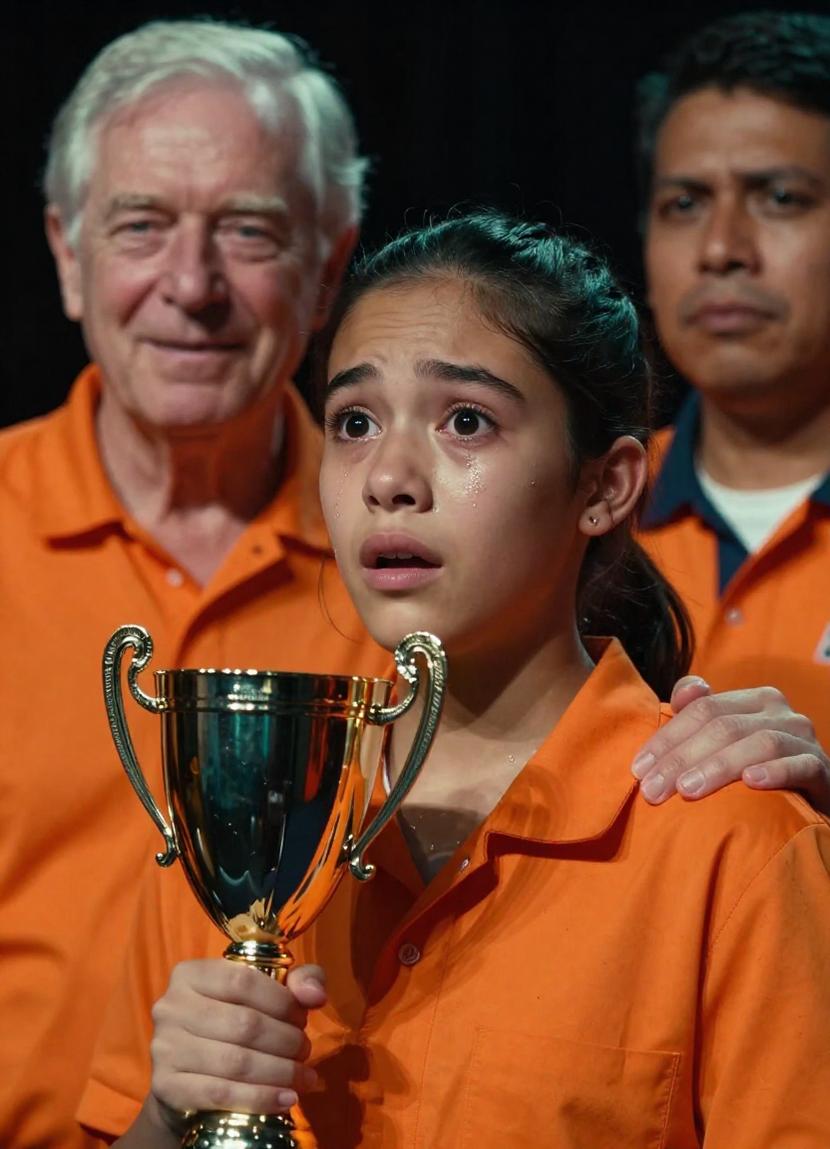
Frozen for a heartbeat, Isela’s breath caught—a burst of joy and disbelief crushing her ribs. Her eyes sought the crowd, landing finally on Mateo at the back, his tired gaze burning bright with silent, incandescent pride.
In that moment, years of cruelty melted like ice in sunlight. She had done it.
Stepping forward, light as air, she accepted the trophy—its polished gleam a beacon. This wasn’t just an award; it was a key unlocking new worlds.
After the ceremony, caught in a joyous chaos of congratulations, Isela stood quietly beside Ethan. Judges lingered, eager to discuss her work; faculty and students offered smiles, the air thick with genuine admiration.
Then, the unexpected.
Mr. Collier beckoned an older man to the stage—simply dressed, yet radiating quiet authority. The man’s silver hair and warm eyes fixed on Isela with a knowing smile.
“Congratulations, Isela,” his voice flowed across the stunned auditorium. “Your project embodied brilliance and heart. Today I’m honored to reveal that the Willowbrook Scholarship Fund has been generously supported for decades by the Navarro family.”
A stunned silence rippled.
Mateo stepped forward, his janitor’s uniform incongruous with the grandeur of the moment. The man introduced as Mr. Alden—his elder relative overseeing the fund—placed a hand on Mateo’s shoulder.
“This is Mateo Navarro, Isela’s father, my grand-nephew, and the steadfast steward of this fund. He chose to remain here, quietly working, to live the values of humility, compassion, and the dignity of labor every day.”
Whispers erupted.
Faces shifted—shock, disbelief. Vanessa’s pale mask twisted among them, eyes wide and shrinking. The school’s social map shattered beneath their feet.
Mateo, once invisible, now stood tall, the true architect of futures quietly shaped.
Mr. Alden’s voice thundered through the hall, steady and clear: “Our core principle is fairness, ensuring no bias or social standing taints the selection. Isela earned this entirely on her own merit—her brilliance and resilience.”
The room fell into a thick, breathless silence.
The lessons whispered for years now roared in revelation. Those hushed conversations about Mateo’s commanding phone calls, the antique watch—the respect from elder teachers—all pieces falling into place.
Through it all, Mateo never told Isela who they really were. Instead, he urged her to forge her own path, to claim her worth beyond titles or wealth—a lesson in dignity that was now living, breathing before the school.
Vanessa’s face flickered through pale, red, and sickly white. The cruel taunts, the public humiliations—they now counted for nothing. Her power unraveling not in defeat, but in the crushing weight of truth.
Teachers approached Mateo uncertainly, their respect mingled with embarrassment. He offered only a small knowing smile and returned to his silent work, custodian by day, steward of dreams always.
Isela stood beside Ethan, quiet, radiant. No tears, no gloating—only a steady gaze meeting those who had once dismissed her with scorn, their eyes dropping beneath hers. Their carefully built social order lay in ruins.
That evening, beneath the glowing twilight, Isela and Mateo sat on their porch swing, watching shadows lengthen across the horizon.
“You knew this day would come, didn’t you?” she whispered.
Mateo smiled, eyes on the fading light. “I hoped so. But I needed you to find your own strength. And you did.”
“Why never tell me who we are?”
“Because your worth,” he said softly, “is not a name but what you choose in the quiet moments. You earned this, Isela—not inherited it.”
She smiled, feeling truth settle deep.
Back at Hawthorne Heights, the halls buzzed with a new energy. Isela walked the same paths, wore the same clothes, but nothing was the same. The cruel whispers were gone, replaced by silence heavy with respect.
“She’s Isela Navarro,” someone murmured reverently.
Gone was the sting of “janitor’s daughter,” replaced by the resonance of triumph born from resilience.
In the weeks that followed, the school transformed—a quieter reverence settled in. Isela, once invisible, now embodied everything Hawthorne Heights aspired to: humility, integrity, relentless spirit.
Students whispered her name—not with mockery, but awe.
Vanessa sat alone in the locker room, haunted by her past cruelty. Her phone screen glowed with memories of scornful posts she now hurried to erase. But deletion could not cleanse the shame of ignorance embraced.
The sharp irony bit hard: a life spent shielding privilege, fragile social power, shattered in truth’s bright glare.
Isela thrived—early to class, lunches in the lab or resting beneath the great oak tree Mateo once favored. Ethan is her silent companion, sharing books and laughter without many words.
Faculty sought her insights. The librarian created a tribute featuring her award-winning project. A bright plaque in the hall declared: “Isela Navarro: Our Future Begins with Water.”
Yet, humility grounded her. Each evening, Florence still cradled their ritual: mopping the east wing with Mateo, punctuated by soft hums and playful mop sprays—a shared symphony of endurance and grace.
One chilly Friday, as Isela collected books, a hesitant shadow approached.
“Hey,” came a soft voice. Turning, Isela met Vanessa, eyes lowered, guarded.
“I was cruel. I didn’t understand. I’m sorry.”
Clumsy but sincere, the apology hung raw in the air.
Isela studied her, weighing the gesture—not warmth, not friendship—just acknowledgement. Enough.
Vanessa’s head dipped, voice fragile. “Okay.” She turned away, a humbled shadow of Hawthorne Heights’ once queen bee.
And Isela? She continued forward, not just a survivor, but a beacon of quiet strength and earned dignity.