The lingering scent of lavender intertwined with the musty embrace of well-loved books—the familiar fragrance of our home—was the last thread of reality I grasped before everything dissolved into a cold, clinical white void. For a decade, Luca had been the center of my universe. Together, we constructed a life—or so I had believed—in the sprawling estate my parents bequeathed me, a sanctuary rich with memories and quiet opulence. He was magnetic, driven, and, as I thought, unshakably devoted. My only supposed flaw in Luca’s eyes was my “delicate emotional balance,” a story he had painstakingly woven over years, each thread a subtle snare.
It started like a whispering poison. Misplaced keys reappeared in my coat after frantic searches, prompting his honeyed, condescending reassurances: “You’re getting forgetful, darling.” Unspoken appointments vanished from my calendar, sabotaging my commitments and forcing me into awkward apologies on his behalf. To friends, he offered well-rehearsed tales of my “anxiety” and “mood swings,” always painting himself as the patient, loving husband enduring my fragility. Luca was a master painter, and my sanity was his canvas—each stroke of doubt expertly crafted to fragment me.
The unveiling of his masterpiece took place at our annual charity gala—an event I once cherished. The days before were a barrage of cutting barbs—my dress, “a bit dull, isn’t it, Isela?”; my speech, doubted and belittled; my contributions dismissed as unnecessary, with a smooth, sinister insistence: “Let me handle the details. You just focus on looking lovely.” By arrival, I was unraveling, second-guessing every breath, every glance.
There, he introduced me to Camille Everhart, the daughter of the titan whose business empire Luca was desperate to entwine with his own. Camille was polished to an icy perfection, her smile a calculated curve that never danced to her eyes. She studied me with an unsettling clinical detachment—as if I were a specimen under a cold spotlight. Luca remained tethered to Camille’s side all evening, manifesting ambition and charm, while I drifted in the crowd’s periphery, shrinking into invisible shadows.
When I finally confronted him, voice frayed with heartbreak and bitter resolve, he transformed my quiet pain into a public performance. “Isela, please,” he intoned, voice sharp enough to draw nearby gazes. “Not here. You know how you get when overwhelmed.” His arm wound around me—not protector, but imprisoner. Camille watched, perfectly pitched sympathy etched across her face. The trap had snapped shut, and I was the caught prey.
That night, in our once-shared bedroom, Luca perched on the edge of the bed, sorrow etched in every line of his face. His hands held mine, but the touch was cold, foreign. “You need rest, my love,” he murmured, voice smooth as silk yet venomous. “A secluded wellness retreat—Tranquil Pines. Just a few weeks to recover your strength. I can’t bear to see you like this.” Exhausted by his relentless manipulation, broken down to believe I was fragile and fractured, I agreed with a hollow nod, desperate for peace.
Tranquil Pines was a gilded cage masquerading as a sanctuary—a sanitarium where the wealthy hid their inconvenient family secrets. My phone was confiscated under the guise of a “digital detox.” My room was plush but fortified with reinforced polycarbonate windows, a prison disguised in serenity. The staff wore polite masks, their hollow eyes unreadable; their scripted kindness felt like mockery. Therapy meant heavy sedatives, drowning my spirit in a fog so thick I barely recognized myself.
Only Luca was allowed visits—once a week, he arrived adorned with flowers and lies. His words were poison coated with honey: all were concerned but agreed this seclusion was for my own good, that I was healing. He was my prison warden cloaked as savior, and the drugs blurred the bars around me.
Two months passed in shadowed haze, my identity dissolving with each sedative-laden dawn. Salvation came quietly—a flicker of defiance reigniting the old Isela within. I began feigning my meds, hiding pills beneath my tongue, discarding them when no one watched. Slowly, the fog lifted, and the truth crystallized with brutal clarity. The inconsistencies, the whispered slanders, Camille’s cold pity at the gala—it all fit into a horrifying picture. Luca wasn’t healing me. He was erasing me.
Trapped, cut off from the world, labeled insane by those mean to care for me, my lifeline came from a name long buried: Adrian Voss, my mother’s estranged brother. Once a ghost from my fractured childhood, a ruthless, brilliant billionaire who had clashed with my parents years before over values and vision. I remembered him clearly at the funeral, pressing a sleek black card into my hand. “If you ever need a war, call this number—not for a favor, for war.”
With help from Mara, a night nurse who glimpsed the ember of life still burning within me, I made that call, trading the diamond earrings my parents had given me for a chance at freedom.
Adrian arrived swiftly—not with condolences or comfort, but with a battalion of stern lawyers who tore apart Tranquil Pines’ façade in hours, wielding threats that would bankrupt the institution twice over. As sunlight bathed my skin for the first time in months, Adrian handed me a tablet. No hugs, no questions—just blunt truth.
“Welcome back, Isela,” he said, voice sharp and devoid of sentiment. “Now, let’s unravel what Luca’s been up to while you were ‘unwell.'”
The screen painted a ruthless timeline of betrayal: Luca siphoning assets from my inheritance into perilous schemes tied to the Everhart empire. Exploiting my ‘illness’ to gain power of attorney, he twisted control of my fortune to force a corporate merger he craved. And the cruelest cut—the digital invitation to his wedding with Camille Everhart, set in two weeks at the grand Everhart estate.
“He’s not just replacing you,” Adrian said grimly, scrolling through damning reports. “He’s funding his own wedding with your parents’ legacy—money he planned to control once you were declared incompetent.”
A fierce, icy fury surged within me, burning away the fragile shell Luca had tried to forge. “He thinks I’m trapped—sedated and silent,” I said, voice calm but resolute.
Adrian lifted an eyebrow. “And what are you?”
“I’m preparing for a wedding,” I replied steadily.
In the next two weeks, we plotted with cold precision. Adrian’s team unearthed every fraudulent transfer, every shell company, evidence of wire fraud meant to inflate Luca’s standing in Camille’s father’s eyes. He wasn’t just a heartless husband—he was a reckless criminal unraveling his own facade.
While lawyers constructed the case, Adrian rebuilt me. No pity, no soft words—strategy. From shooting ranges teaching steady aim to corporate boardrooms where he unveiled the empire my parents had left, awakening my dormant prowess. Gone were Luca’s preferred silks of submission; instead, I chose armor woven from silk and steel. I was no longer a broken woman. I was rearming.
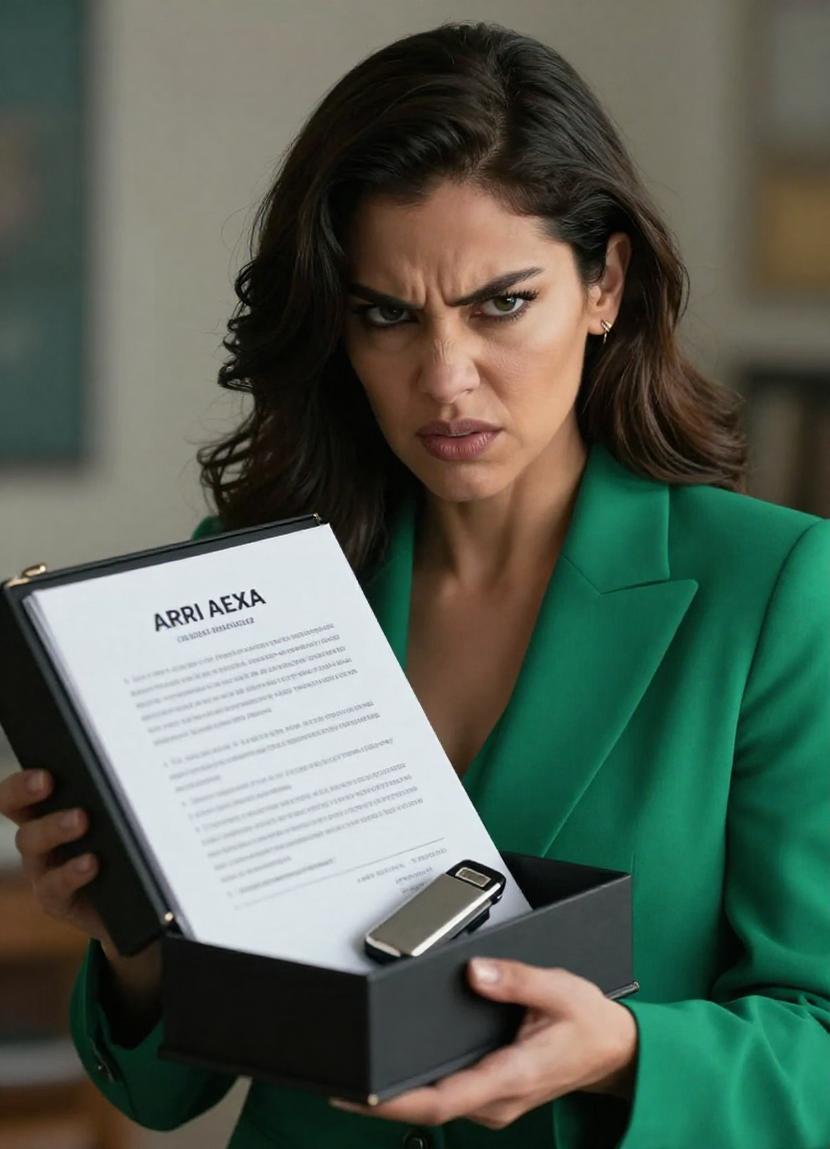
On the wedding day, calm reigned in my veins as I rode in the polished Silverhawk, a masterpiece of engineering worth more than Luca’s coveted estate. Adrian drove, expression unreadable, dressed in tailored authority. In my lap, an Asprey gift box wrapped in dark green ribbon—a gift like no other.
We bypassed the grand entrance, gliding quietly onto the manicured lawn as notes from the string quartet swirled with the late afternoon breeze. A hush rippled through the crowd; every eye snapped to us. Luca and Camille, poised beneath the cascade of white roses, froze, their annoyance shifting to raw shock. Luca’s face drained of color.
I alighted from the car, emerald green suit sharp and commanding, hair styled in a regal cut. No fragile, weeping wife had returned—only a queen reclaiming her throne.
I walked the length of the aisle, heels sinking softly into velvety grass as the crowd parted before me—a Red Sea of stunned witnesses. I halted before Camille’s father, whose stone expression never faltered, though his eyes flickered between me and his soon-to-be son-in-law, who now looked like a broken man.
The officiant, flustered and faltering, began, “If anyone has any objection to this union…”
“Oh, please,” I interrupted, voice crystal clear through a subtly placed microphone. “I’m not here to object. I’m here to present a wedding gift.”
The box was passed to Luca, hands trembling as he released the ribbon’s hold. Inside lay two treasures on black velvet.
First, a meticulously bound dossier: a complete accounting of the Voss Family Trust—that sacred legacy left to me by my parents. “This,” I declared, voice ringing with precision, “is the dissolution notice. As of this morning, the trust is dissolved. All assets, shares, and properties reclaimed. The lavish expenses for this wedding…”—a sweeping gesture to the guests, the music, the grandeur—“…will go unpaid. Your empire is an empty shell, Luca. You are bankrupt.”
A collective gasp trembled through the crowd. Luca’s mask shattered under the weight of his ruin.
“But I have one more gift,” I said, turning to Camille’s father.
The second item was a sleek steel flash drive. “Within lies indisputable proof of Luca’s criminal web: shell companies, fraudulent reports, embezzlement—the artifice underpinning his rise. He isn’t an asset to your lineage, Mr. Everhart. He’s a liability. A criminal.”
Camille recoiled, disdain carved into her features. Her father’s steady gaze shifted between the drive and Luca. In it, I saw the sound of a steel vault locking, final and unforgiving. Luca was no longer a man to them—a failed investment, condemned.
“I believe my work here is done,” I said, eyes locked onto the hollow ambition once called my husband. “You wanted my world, Luca. Here it is—all that remains.”
Without a backward glance, I turned to the Silverhawk. Its tires whispered against the grass as we departed, leaving the wedding—and Luca’s life—dissolving into chaos. Heated words murmured between Camille and her father, whispers igniting like wildfire as guests stirred uneasily. His reign was over.
Adrian broke the silence. “What now?”
I gazed forward, sun warming my face as if blessing the future. “A new beginning.” And, for the first time in years, freedom tasted real.
Weeks later, the scandal dwindled from headlines, but consequences thundered in corporate courts and whispered boardrooms. Luca’s name was blacklisted, investigations launched, and Camille’s father severed all ties with the Thorne Group’s disgraced former executive. Luca vanished—some said overseas escape, others whispered drowning in litigation and whiskey.
I didn’t care.
The home was mine again—not the prison he tried to build, but the sanctuary my parents had gifted. I purged his cold minimalism, replacing it with deep jewel tones, warm wood, plush velvet drapes—and that familiar, soothing lavender scent. The house was no longer a showroom; it was alive. It was mine.
In the library, untouched for years, I found a hidden letter from my mother, nestled within a worn volume of poetry. Her delicate penmanship read:
“For my Isela— This house is more than walls and words. It’s memory. Strength. When doubt clouds your heart, come home. Let its silence remind you of your voice.”
Tears fell—not of fear, but relief. Her voice never truly left me; it had only been buried beneath Luca’s noise.
Adrian visited often, stoic and brief. One quiet afternoon over dark roast, he remarked, “You’re stronger than your parents ever imagined.”
I smiled, tucking a loose strand behind my ear. “Or maybe they just knew I’d find my way.”
He nodded. “Options lie before you—steer the company, sell it, begin anew.”
Breathing the clarity of freedom, I said, “I’ll take a year off. Travel. Breathe. Maybe open a small, quiet art gallery.”
He lifted his cup in a toast. “To Isela 2.0.”
Seasons spun onward. On a dusky Cinque Terre evening, sketchbook in hand, I watched waves kiss jagged stones. Here, I was anonymous—no whispered judgments, no fractured whisper of scandal. Just a woman with her art and her name.
On the final page, I wrote:
“He tried to erase me. But I remembered. And in remembering, I became whole.”